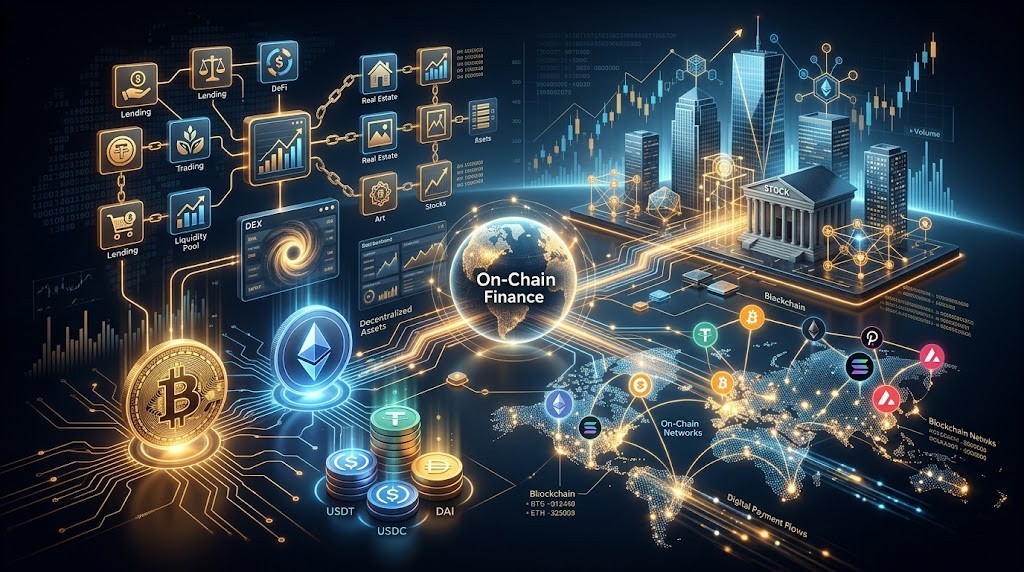
The cryptocurrency market is gradually entering a stage where blockchain technology is being evaluated for more than speculative trading. Bitcoin remains the dominant digital asset, but some of the most important developments across the industry are now taking place in stablecoins, decentralized finance, tokenized assets and blockchain-based financial infrastructure.
This shift is changing the way investors look at the market.
Instead of focusing exclusively on whether Bitcoin or Ethereum will move higher, market participants are increasingly asking a broader question: How much real economic activity is actually moving onto blockchain networks?
That question could become particularly important during the next stage of the crypto market cycle.
Bitcoin Still Sets the Market Direction
Bitcoin continues to act as the primary benchmark for the digital asset market.
Its large market capitalization, deep liquidity and growing institutional presence make BTC the first asset many investors consider when entering the cryptocurrency sector.
However, Bitcoin’s role is gradually evolving. It is no longer simply viewed as a speculative digital currency. For many investors, it has become a portfolio asset that can provide exposure to a different form of digital scarcity.
The relationship between Bitcoin and the broader market remains important. When BTC establishes a strong upward trend, capital often begins moving toward Ethereum and other large-cap cryptocurrencies. When Bitcoin experiences a sharp correction, altcoins can face significantly greater selling pressure.
This makes Bitcoin’s price structure an important indicator, but it does not explain everything happening underneath the market.
Stablecoins Are Becoming Crypto’s Financial Backbone
Stablecoins may ultimately become one of the most important applications created by blockchain technology.
Their appeal is relatively simple. They combine the transferability of blockchain-based assets with a value designed to remain relatively stable.
That makes them useful for trading, payments, remittances, decentralized finance and settlement.
Ethereum remains one of the most important stablecoin networks. Fidelity Digital Assets reported that Ethereum hosted approximately $164 billion in stablecoin supply as of March 31, 2026, representing roughly half of the global stablecoin market at that time.
The significance of this goes far beyond crypto exchanges.
Imagine a business sending money internationally without relying on several intermediaries or waiting days for traditional settlement processes. Blockchain-based stablecoins could potentially make that process faster and more transparent.
This is why stablecoins are increasingly being discussed as financial infrastructure rather than simply another cryptocurrency category.
Why Stablecoin Growth Matters for Blockchain Competition
Stablecoin liquidity can create a powerful network effect.
When a blockchain attracts stablecoin liquidity, decentralized exchanges can become more efficient. More liquidity can attract traders. More traders can attract developers, while developers can create additional applications that attract more users.
This creates a cycle in which liquidity and utility reinforce each other.
Ethereum has benefited significantly from this effect, but competing networks are also attempting to capture stablecoin activity.
Solana, BNB Chain and other Layer-1 ecosystems have been competing through lower transaction costs, faster execution and specialized application environments.
The competition is therefore no longer simply about which blockchain has the fastest transactions.
The more important question is which networks can convert technical advantages into sustainable economic activity?
DeFi Is Moving Toward a More Mature Model
Decentralized finance, or DeFi, remains another major component of blockchain adoption.
The first major wave of DeFi was heavily influenced by yield farming, token incentives and speculative opportunities. While those activities helped attract users, they also demonstrated the risks associated with unsustainable economic models.
The next phase of DeFi is likely to place greater emphasis on practical financial services.
Decentralized exchanges can provide global access to markets. Lending protocols can allow users to borrow against digital assets. Stablecoins can provide liquidity without requiring users to hold volatile cryptocurrencies.
As the sector matures, investors may increasingly distinguish between protocols that depend on incentives and those that generate genuine recurring demand.
This distinction could become one of the most important factors in evaluating DeFi projects.
Ethereum and the Layer-2 Ecosystem
Ethereum’s long-term position is also closely connected to Layer-2 networks.
Instead of processing every transaction directly on Ethereum’s main network, Layer-2 systems can handle activity separately while maintaining a connection to Ethereum’s settlement infrastructure.
This approach can improve scalability and reduce costs for users.
However, it also creates a new economic question.
If users increasingly interact with applications through Layer-2 networks, where does the long-term value accumulate?
Ethereum may benefit through settlement demand, security and liquidity, while individual Layer-2 networks could capture application-specific activity.
The result could be an increasingly interconnected ecosystem rather than a single blockchain dominating every use case.
Solana’s Growing Role in On-Chain Markets
Solana has emerged as one of Ethereum’s most important competitors in several areas of on-chain activity.
Its architecture emphasizes high throughput and relatively low transaction costs, making it attractive for applications where users perform large numbers of transactions.
Research from Galaxy found that Solana processed approximately $650 billion in stablecoin transaction volume during February 2026, while stablecoin market capitalization on the network reached about $15.45 billion during the first quarter.
These figures demonstrate why Solana deserves attention beyond its token price.
The network is increasingly being evaluated according to actual economic activity.
Its future success, however, will depend on whether that activity remains sustainable and continues expanding beyond speculative trading.
Tokenized Assets Could Create a New Source of Demand
Another potentially transformative development is the tokenization of real-world assets.
Financial instruments such as government securities, funds and other assets can potentially be represented through blockchain-based tokens.
The benefits can include faster settlement, programmable transactions and broader access to financial markets.
For blockchain networks, tokenization represents a major opportunity because it could bring traditional financial activity directly onto public or permissioned networks.
Ethereum has a strong position due to its institutional infrastructure and liquidity, while Solana and other networks are also developing capabilities for tokenized assets.
The competition could become significant as financial institutions determine which networks provide the best combination of security, liquidity, compliance and scalability.
Institutional Investors Are Becoming More Selective
Institutional participation is another factor changing the structure of the crypto market.
Large investors are increasingly gaining access to digital assets through regulated products and professional investment infrastructure.
However, institutional interest does not mean investors will automatically buy every cryptocurrency.
In fact, the opposite may happen.
Professional investors tend to examine liquidity, volatility, custody, regulatory conditions and fundamental demand more closely.
Coinbase’s 2026 institutional survey found that many institutions remained optimistic about crypto while simultaneously increasing their focus on risk management and position sizing.
This suggests that the next market cycle could reward established networks and strong infrastructure more than short-lived narratives.
The Importance of On-Chain Data
One of the biggest advantages of blockchain technology is transparency.
Unlike traditional financial systems, many blockchain networks allow market participants to observe transaction activity, token movements and liquidity directly on-chain.
This creates opportunities for investors to analyze the market differently.
Instead of looking only at price charts, investors can monitor:
- Stablecoin supply
- Active addresses
- Transaction volume
- DeFi liquidity
- Exchange flows
- Developer activity
- Tokenized asset growth
- Network fees
None of these indicators should be considered independently, but together they can provide a more complete picture of network health.
What Could Drive the Next Phase of Crypto Growth?
Several trends could become important over the coming months.
Stablecoin adoption could accelerate as businesses and financial institutions explore blockchain-based settlement.
DeFi infrastructure could mature as developers focus more on sustainable products rather than temporary incentives.
Tokenization could bring traditional financial assets onto blockchain networks.
Layer-2 adoption could make blockchain applications cheaper and more accessible.
Institutional participation could provide additional liquidity while also increasing demand for regulatory clarity and professional infrastructure.
At the same time, macroeconomic conditions will remain important. Interest rates, inflation, liquidity and broader investor sentiment can still have a significant influence on crypto prices.
Risks Investors Should Not Ignore
The growth of blockchain finance does not eliminate risk.
Smart-contract vulnerabilities, regulatory uncertainty, market manipulation and excessive leverage remain important concerns.
There is also a risk that some projects attract users temporarily through incentives without developing sustainable economic activity.
For this reason, investors should avoid judging a blockchain solely by transaction numbers or token price performance.
A stronger analysis considers whether users are returning, whether applications generate genuine demand and whether the ecosystem can continue operating without excessive subsidies.
Final Outlook
The cryptocurrency market is gradually moving toward an infrastructure-driven phase.
Bitcoin remains the market’s primary benchmark, but the broader opportunity may be found in the financial systems being built around blockchain technology.
Stablecoins are creating new methods of transferring value. DeFi is developing alternative financial services. Layer-2 networks are expanding blockchain scalability, while Solana and other Layer-1 networks continue competing for users and liquidity.
Meanwhile, tokenization could bring parts of the traditional financial system onto blockchain networks.
For investors, this creates a more complicated but potentially more mature market.
The most important question is no longer simply which cryptocurrency will rise next?
A better question may be:
Which blockchain networks are becoming useful enough that users, businesses and financial institutions continue to rely on them regardless of short-term market sentiment?
If the crypto industry can answer that question through sustainable adoption, the next market cycle could be driven by something much stronger than speculation: real-world financial activity moving on-chain.
This article is for informational and educational purposes only and does not constitute financial or investment advice.